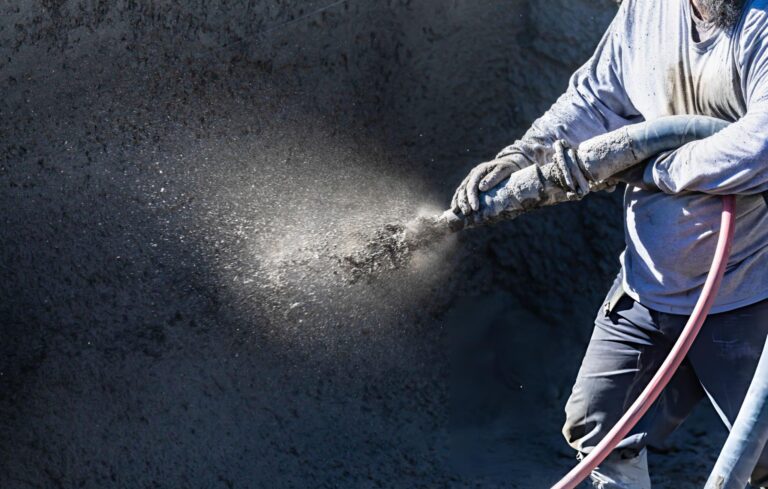
Concrete Spraying

Concrete Spraying Service Overview
Concrete spraying is a modern construction technique used to apply concrete or mortar through a high-pressure hose and nozzle onto surfaces. This method is widely known for its speed, flexibility, and strength.
It is commonly used for structural repairs, surface reinforcement, slope stabilization, tunnel linings, swimming pools, and architectural features. Concrete spraying allows material to be placed precisely where needed, even on vertical or overhead surfaces, making it a highly efficient alternative to traditional concrete placement methods.
What Is Concrete Spraying?
Concrete spraying is the process of projecting a concrete or mortar mix at high velocity onto a prepared surface. The force of application compacts the material, creating a dense, durable layer with strong adhesion. This technique eliminates the need for conventional formwork in many applications, reducing both time and cost.
How the Process Works
The process begins with preparing the concrete or mortar mix to the required consistency. The mix is then fed into a spraying machine and conveyed through a hose to a nozzle. Compressed air propels the material onto the target surface at high speed. As the concrete impacts the surface, it compacts and bonds tightly, forming a strong and uniform layer.
Types of Concrete Spraying Methods
Concrete spraying can be performed using different techniques depending on project requirements.
Dry Mix Spraying
In the dry mix method, dry cement and aggregates are conveyed through a hose, and water is added at the nozzle. This allows the operator to control the water content and consistency during application. It is commonly used for repair works and smaller projects where flexibility is important.
Wet Mix Spraying
In the wet mix method, concrete is fully mixed with water before being pumped through the hose. This method provides better consistency and higher productivity, making it suitable for large-scale projects and structural applications.
Applications of Concrete Spraying
Concrete spraying is used across a wide range of construction and repair projects.
Structural Repair and Strengthening
One of the most common uses of concrete spraying is repairing damaged or deteriorated concrete structures. It restores load-bearing capacity and improves durability in bridges, buildings, and industrial facilities.
Tunnel and Underground Construction
Concrete spraying is widely used for tunnel linings and underground stabilization. It provides immediate support to excavated surfaces, improving safety and reducing the risk of collapses.
Slope and Embankment Stabilization
In geotechnical projects, sprayed concrete is used to stabilize slopes and embankments. It prevents erosion and strengthens soil surfaces, especially in areas prone to landslides.
Swimming Pools and Water Features
Concrete spraying allows for the creation of complex shapes and smooth finishes, making it ideal for swimming pools, fountains, and decorative water features.
Architectural and Decorative Applications
Sprayed concrete can be shaped and textured to create architectural elements, sculptures, and themed environments. It offers design flexibility that is difficult to achieve with traditional casting.
Benefits of Concrete Spraying
Concrete spraying offers several advantages over conventional concrete placement methods.
Speed and Efficiency
The spraying process is significantly faster than traditional formwork-based construction. Large areas can be covered in a short time, reducing project timelines.
Strong Adhesion and Durability
The high-velocity application compacts the concrete, resulting in excellent bonding and reduced voids. This produces a dense and durable surface with long-term performance.
Reduced Formwork Requirements
Because sprayed concrete adheres directly to surfaces, it often eliminates the need for extensive formwork. This reduces material costs and labor requirements.
Design Flexibility
Concrete spraying allows for curved, irregular, and vertical surfaces to be constructed easily. This flexibility supports both functional and aesthetic design goals.
Equipment Used in Concrete Spraying
Specialized equipment ensures accurate and consistent application.
Spraying Machines
These machines pump or convey the concrete mix through hoses to the nozzle. They vary in size and capacity depending on the scale of the project.
Nozzles and Air Compressors
Nozzles control the flow and direction of the sprayed material, while air compressors provide the pressure required for projection and compaction.
Hoses and Delivery Systems
High-strength hoses transport the concrete mix from the machine to the nozzle. Their length and diameter are selected based on project needs and site conditions.
Surface Preparation for Concrete Spraying
Proper preparation is essential for achieving strong adhesion and long-lasting results.
Cleaning and Roughening
The surface must be free from dust, grease, loose particles, and contaminants. Roughening the surface improves bonding between the sprayed concrete and the substrate.
Moistening the Substrate
Lightly dampening the surface before spraying prevents rapid moisture loss and enhances adhesion. It also reduces cracking caused by shrinkage.
Installing Reinforcement
In structural applications, steel mesh or reinforcement bars may be installed to improve strength and load-bearing capacity.
Safety Considerations in Concrete Spraying
Safety plays a vital role in concrete spraying operations.
Operator Training and Skill
Skilled operators are required to control nozzle angle, distance, and flow rate. Proper technique ensures uniform application and minimizes rebound and material waste.
Personal Protective Equipment
Workers should wear helmets, gloves, protective clothing, goggles, and respiratory masks. This protects against dust, noise, and high-pressure material impact.
Site Safety Measures
Barriers, warning signs, and proper ventilation should be used to protect workers and bystanders. Equipment must be inspected regularly to prevent malfunctions.